
You're at: SolvInnov » All the posts

94% of executives have an innovation problem

Let's Fix That!

value | innovation | enterprise

You're at: SolvInnov » All the posts

subscribe to feed
Innovation Essentials
What is Innovation?
Understanding Service
Making S-D logic Approachable

All Journeys
  • Background
  • Case Study
  • FAQs
  • In Practice
  • Tools
  • Future Articles
    All
    Books
    Papers
    Web Articles

    References
    Innovation Essentials
    What is Innovation?
    Understanding Service
    Making S-D logic Approachable

    All Journeys
  • Background
  • Case Study
  • FAQs
  • In Practice
  • Tools
  • Future Articles
    All
    Books
    Papers
    Web Articles

    References

    All the posts

    Below you can find all the articles on this site ordered by when they were last updated starting with the newest.  Try here if you are looking for the site’s videos or here if you are after info on any of the books I mention on the site.

    I hope you find what you are looking for!

    Comment navigation
    • First Page First Page
    • Previous
    • Page 1
    • Page 2
    • Page 3
    • Page 4
    • Current Page 5
    • Page 6
    • Page 7
    • Page 8
    • Previous
    • Last Page Last Page
    Diffusion of Innovation
    adopter types crossing the chasm diffusion early group imitators influence majority mavens moore bass people rogers social network tipping point
    Posted on 31st Mar 2019
    Last Updated 2nd Jun 2021
    Category Innovation Essentials
    31/3/19  2/6/21  #Innovation Essentials
    post

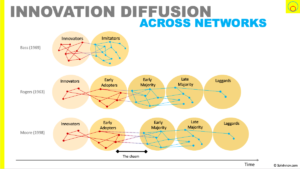
    Innovations diffuse - knowledge spreads - across a social system through communication channels over time.

    We'll take a network-centric view of diffusion and see how Bass' model and Rogers' adoption curve help us understand diffusion

    Then we'll look at Moore's crossing the chasm and Maloney's 16% rule to understand some issues. And finally look at the tipping point, and Gladwell's mavens, connectors and salesmen.

    Reading time <14 mins
    Read Article
    Innovation adoption
    change management adoption decision diffusion social-network early adopters knowledge-step perceived-attributes early majority adoption rate rejection resistance relative-advantage step laggards
    Posted on 31st Mar 2019
    Last Updated 30th May 2021
    Category Innovation Essentials
    31/3/19  30/5/21  #Innovation Essentials
    post

    Innovation adoption is when individuals or organisations decide and start using an innovation.

    We'll look at the classic adopter types, the adoption decision steps, and how adoption can be accelerated

    But also we'll put the adoption decision in the context Christensen's Job theory (big and little hires). And see how resistance to innovation should be included in the classic adoption steps

    Reading time <14 mins
    Read Article
    Operant resources are the fundamental source of strategic benefit
    advantage benefit basic composite hierarchy interconnected cultural human informational operand resource operant resource organisational relational physical social
    Posted on 15th Jul 2020
    Last Updated 27th May 2021
    Category Making SD-Logic Approachable
    15/7/20  27/5/21  #Making SD-Logic Approachable
    post

    "Our people are our key advantage" - a phase we hear often.

    With service-dominant logic we get an insight into why. And it starts with seeing that service is the application of skills and competence. And they are applied by people - a form of operant resource - resources that act on other resources to lead to value (co-)creation

    But we can also see processes as operant resources (as they codify beneficial skills and competencies).

    And it turns out, there is a useful hierarchy of operant resources.

    Reading time <8 mins
    Read Article
    Making Service-Dominant Logic More Approachable
    actors beneficiary 'basis of exchange' operant-resources 'goods distribute service' institutions phenomenological 'foundational premises' innovation 'what, who and how'
    Posted on 27th Nov 2019
    Last Updated 27th May 2021
    Category Making SD-Logic Approachable
    27/11/19  27/5/21  #Making SD-Logic Approachable
    post

    A service-dominant logic approach requires us to stop seeing a goods vs service world where service is a poor relative to goods. And instead, embrace a service-first world where goods help us transport a service.

    At first glance, this might seem that we are challenging the over 300-year old goods-dominant view of our world. But it is an evolution in thinking, acting and behaving rather than a revolution. One that requires us to stop seeing a goods vs service world and instead embrace a service-first world where goods help us transport a service.

    However, they are unlikely to light up the management world. Or get the attention they need. Given the often confusing words choices, like phenomenological, or using words that have a different meaning than usual, as in the case of institutional.

    Let's make service-dominant logic more approachable by doing two things:

    • Group premises together into the clear "what", "who" and "how"
    • Explore what the definitions really mean

    Reading time <12 mins
    Read Article
    Innovation Resistance
    economic functional traditions usage patterns norms opposition perceived image physical postponement social rejection resistance
    Posted on 16th May 2019
    Last Updated 23rd May 2021
    Category Innovation Essentials
    16/5/19  23/5/21  #Innovation Essentials
    post

    Innovation resistance – users postponing, rejecting, or even objecting/demonstrating against – is the sadly neglected child.

    We are all familiar with its sisters: diffusion and adoption. Yet, we see innovations failing again and again. And not addressing innovation resistance is a candidate for why this is so. As well as for why 94% of executives are disappointed with innovation performance. Why? Well, in order to get adoption we have to:

    1. address Rogers’ classic adoption variables, and
    2. remove resistance (opposition, rejection and postponement) to the innovation
    Too often we only see and address the point 1. Yet:
    • “innovation resistance seems to be a normal, instinctive response of consumers” (Sheth and Ram, 1989)
    • "customer resistance is usually one of the greatest risks to innovation" (Heidenreich & Kraemer, 2015).

    In this article, we look at innovation resistance and why it occurs.

    Reading time <12 mins
    Read Article
    Innovation: Diffusion, and What Network Topology can tell us
    Posted on 3rd Sep 2019
    Last Updated 22nd May 2021
    Category Innovation Essentials
    3/9/19  22/5/21  #Innovation Essentials
    post
    Work in Progress Early Thoughts

    Diffusion happens across a social network. Can we take advantage of that network's structure to accelerate diffusion?

    To do so, we look at the network's topology. Its centricity, density, weak ties, structural holes etc

    Which. in plainer speak, are the influencers, and Gladwell's Mavens, connectors etc. And where we might need to target a few innovator types, or many

    Reading time <5 mins
    Read Article
    We have an innovation problem…
    94% unhappy Firm has only 2 purposes forgotten why innovate get myopic goods-dominant logic innovation definition is wrong ideas-first misalignment perform theatre roadblocks 54% unable bridge the gap
    Posted on 18th Aug 2018
    Last Updated 20th May 2021
    Category Background
    18/8/18  20/5/21  #Background
    post

    "94% of executives are unsatisfied with innovation performance". Yet "84% see innovation as important to growth"! And "54% of companies struggle to bridge the gap between innovation and business". Worse; "very few executives know what the problem is and how to fix it"!

    We have forgotten the basics. Firstly that "the firm has two, and only two activities: marketing and innovation". And that "people don't want to buy a 1/4 inch drill, they want a 1/4 inch hole".

    Instead, we (accidentally?) embark on innovation theatre, misalign execution with vision, and forget there is resistance to innovation. We miss following service-dominant logic. Which drives customer-centric thinking, and co-value generation; is a natural home for job-to-be-done and blue ocean theories; helps us minimise marketing myopia; and focuses us past point of sale, to additional services, servitization of goods, and the circular economy.

    Reading time <10 mins
    Read Article
    Diffusion of Innovation II – Bass Diffusion, let’s get Mathematical…
    adoption coefficients curve diffusion generation influenced market predictions real-life rogers sales service size uses values
    Posted on 28th Apr 2019
    Last Updated 20th May 2021
    Category Innovation Essentials
    28/4/19  20/5/21  #Innovation Essentials
    post

    How should you build up your supply chain? What are the real market sizes of Rogers' adopter types? When is best to launch the next generation of your innovation?

    To answer those, we take a deeper look at the mathematics behind Bass' Diffusion Model

    The maths helps us understand the split of innovator and imitator types - captured as two co-efficients in the formula. That allows us to understand where to apply internal and external influence. We can use existing sales (or a comparator) to derive these two co-efficients and therefore predict adoption. That helps us manage supply chains and real market size. Additionally, we can determine when it is best to launch the next generation of the innovation (and see what happens when we lauch to early or late)

    And, best of all...it all fits real life!

    Reading time <14 mins
    Read Article
    The purpose of an Enterprise
    Posted on 14th May 2021
    No updates made
    Category Exploring Value, Uncategorized
    14/5/21  #Exploring Value, Uncategorized
    post
    Work in Progress Early Thoughts
    The Big Picture… If beneficiaries need help in making progress with some aspect of their life, who is it that can help them? It is the enterprises – individuals, firms, multinational conglomerates, non-profits, entrepreneurs, start-ups etc. And these all have one thing in common. They are instances of a: value co-creation enabling system that is […]
    Reading time <1 min
    Read Article
    What is a Value Proposition?
    Posted on 1st May 2021
    No updates made
    Category Exploring Value, Uncategorized
    1/5/21  #Exploring Value, Uncategorized
    post
    Work in Progress Early Thoughts

    A value proposition details how the offer will help a beneficiary make progress.

    I've defined this as the proposed value (whereas realised value is the amount of value co-created)

    We can use a formula way to describe a value proposition:

    1. I (beneficiary)
    2. who (functional progress being sought [job to be done, hindrance to avoid, problem to solve])
    3. the (product/brand name) is a (product category)
    4. that (functional and non functional progress offered)
    5. unlike (primary competitor alternatives), (product/brand name) (primary differentiation statement).
    Reading time <3 mins
    Read Article
    Comment navigation
    • First Page First Page
    • Previous
    • Page 1
    • Page 2
    • Page 3
    • Page 4
    • Current Page 5
    • Page 6
    • Page 7
    • Page 8
    • Previous
    • Last Page Last Page